
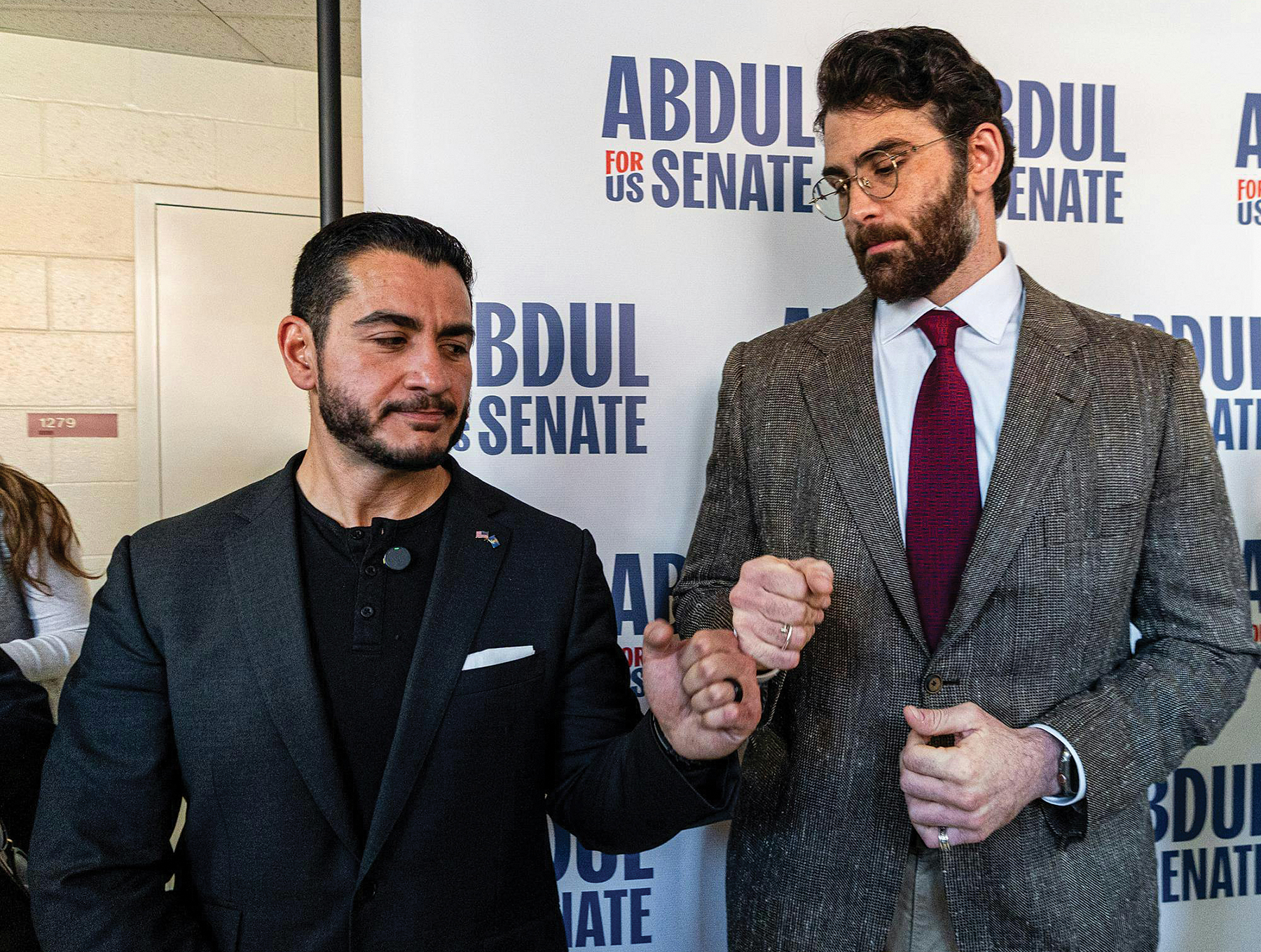
Call it the Michigan Quandary.
The Great Lakes State presents several groups with a real dilemma. For moderates, the predicament is whether to support a Senate candidate whose outlook is congruent with many of the precepts of democratic socialism even though the candidate himself doesn’t describe himself that way. For democratic socialists, the conundrum is how prominently they should align themselves with Dr. Abdul El-Sayed, for fear that association with him will repel undecided voters. For many Jews, this is a catch-22 moment, where the solution (to produce a Democratic wave in the midterm congressional elections) is in conflict with the problem (the comments El-Sayed has made about Israel, which he has called “bloodthirsty”).
The confluence of these kinds of dilemmas is rare but not unprecedented. Southerners voted Democratic in the Franklin Roosevelt era despite the New Deal’s embrace of big government and the presence of Blacks in the FDR coalition. Female voters supported Bill Clinton despite his affair with a woman 27 years younger than he was and, as a White House intern, clearly a subordinate to him. Business executives backed Donald Trump in 2024 despite their conviction that he was a vulgar, louche figure but one whose views on taxation were congenial to them.
Thus El-Sayed and Jewish Democrats.
Jewish Republicans – as the presence of Ryan Berman, a two-term member of the state legislature elected in 2018 demonstrated – are not unknown. Those voters are spared any angst; they have a GOP Senate candidate to support: Rep. Mike Rogers, generally considered slightly ahead in his fight with El-Sayed. Besides, there will be considerable Jewish institutional financial support for Rogers, though the value of that is not assured; AIPAC spent $32 million in its unsuccessful effort to defeat El-Sayed, who before the primary didn’t confine his criticism to Israeli Prime Minister Benjamin Netanyahu, telling MS NOW’s “Morning Joe” program, “Don’t forget that we’ve been talking about an illegal apartheid regime for a very, very long time, and that supersedes Netanyahu himself.”
But a general election campaign is an entirely different matter.
For starters, the voting group is larger than it is in any primary. As any sports fan knows, there is more attention to the finals than to the semi-finals, and the November election is the political equivalent of the finals. It is arguable that AIPAC’s financial offensive against El-Sayed considerably diminished his margin of victory, which was nowhere near the poll soundings, which showed him in a comfortable, by some measures almost insuperable, lead against Rep. Haley Stevens.
Already three big-time Jewish Democratic funders have indicated they’ll work to elect Rogers. You don’t see that every day in a midterm election period where the Democrats, in striking distance of taking over the Senate, are struggling to protect a seat they already hold. (Sen. Gary Peters declined to run for re-election.)
This is why the Jewish vote, though only at 1.4 percent of the electorate according to the American Jewish Population Project at Brandeis University, is important, perhaps critical.
Two years ago, Trump defeated Kamala Harris by 1.4 percentage points. Though the two figures are identical, it now is clear that the entire 1.4 percentage points that account for the Jewish share of the electorate is not going to vote for the Democratic candidate, El-Sayed. Several factors now come into play:
Does the disapproval rating of the president – now 62 percent, according to the Economist/YouGov poll taken early this month – nudge some, or many, Independents into the Democratic tent, despite some of their misgivings about El-Sayed? Are Jews – 50% of whom believe Trump doesn’t support Jewish people, as opposed to 42% who believe he does at least somewhat, according to a June Associated Press-NORC Center for Public Affairs Research survey – willing to aid a party held by the president instead of siding with a potential lawmaker who would be a sworn enemy of him?
A second factor, completely apart from Israel and antisemitism: How congenial are Jews, nationwide and in Michigan, to political notions that approach socialism even if those views are not overtly part of the Democratic Socialists of America platform? At times in the past century, even before that, many Jews have embraced socialist views and even the socialist identity. But since then, Jews have glided into the American mainstream, with an economic and cultural stake in the status quo to which they have come to belong. The recent spike in antisemitism has, to be sure, eroded that confidence if not that status, but are Jewish voters willing to associate themselves with a creed that takes aim at the very foundations of a political and economic system that, despite decades of resistance, eventually, and nearly fully, welcomed them?
“To view this election as solely about Israel is an oversimplification,” Halie Soifer, CEO of the Jewish Democratic Council of America and who was reared in Michigan, wrote earlier this month. “Jewish voters’ concern with El-Sayed and other far-left candidates is rooted in concern for our safety and security given rising antisemitism and antisemitic violence, including when Jews are blamed for the actions of Israel, as we saw earlier this year at Temple Israel in Detroit.”
Now, yet a third question: What kind of outreach to Jews will, or can, El-Sayed make? He swiftly made an attempt to assure Jews, saying, “My commitment to Jewish safety is the same as my commitment I have to the safety of my own kids. We have a responsibility to take on antisemitism in all now its forms wherever we see it. It’s the same responsibility we have to take on Islamophobia. I know what it’s like to be discriminated against for how I pray.”
Shortly after the attack on New York’s Central Synagogue last week, Mayor Zohran Mamdani made a similar comment. “Jewish New Yorkers,” he said, “should be able to go to their synagogue without having to fear for their lives.”
Eight months into his mayoralty, Mamdani is still trying to persuade skeptical New York Jews. El-Sayed has a little more than 10 weeks to do the same. Θ
David M. Shribman, who won a Pulitzer Prize as Washington bureau chief of The Boston Globe, is executive editor emeritus of the Pittsburgh Post-Gazette and teaches at Carnegie Mellon University and McGill University.


