
Bubbling beneath the new debate over the place of Jews in the United States lies a set of fundamental questions that have been unresolved for three-quarters of a century, perhaps for far longer.
They get to the heart of the disquiet many Jews feel today, they raise uncomfortable geopolitical questions, they challenge many of the fundamental notions about the way American Jews regard their own security, and they threaten many of the assumptions and convictions they have about Israel.
What exactly is antisemitism? Is it a creed or a prejudice? What are its ancient origins? How do longstanding biases shape the current surge in anti-Jewish actions and sentiments? What place does Israel play in post-World War II antisemitism? Is it caused by the response to Israel’s reaction to the Hamas invasion of Oct. 7, 2023 – or was it merely reignited by it?
And do any of these questions really matter at all?
These are the debates that are raging in Congress, in American universities, in synagogues – and, in slightly different forms, in Jewish communities around the globe.
These are not, of course, new questions, yet they have a distinctly modern tinge. The Hamas invasion changed everything, not only in Israel, not only in the broader Middle East, not only on campus, not only in the White House, not only among Jews. They unleashed a fury of debate, and of intense emotion. They have provoked fresh looks at history and at contemporary politics. They revived ancient biases and equally timeworn fears.
It should be no surprise that there is a flood of notions, hypotheses, convictions, impulses, and books that deal with this question. Dozens of books on antisemitism and the position of Jews in the contemporary world have been released in recent months; Dara Horn’s “The Final Solution to the Jewish Question” and Peter Beinart’s “Being Jewish After the Destruction of Gaza” are among them.
Two of these volumes stirred conversation and controversy far beyond the U.S. Jewish community. The fact that they take very divergent angles speaks to the complexity of these issues, and ultimately to the passions they provoke.
“Facing antisemitism … was mostly the Jewish problem of the Old World, with its expulsions, Inquisition, ghettoes, pogroms, and Holocaust,” writes Pamela S. Nadell, onetime president of the Association of Jewish Studies and the director of the Jewish Studies Program at American University, explaining that when antisemitism emerged in the U.S., “it was dealt with quickly and never approached the level of Europe’s outrages.”
 Dozens of books on antisemitism and the position of Jews in the contemporary world have been released in recent months.
That was the conviction for generations. But in “Antisemitism, An American Tradition,” Nadell demonstrates that antisemitism has been a subterranean river under the U.S. political, cultural and social landscape, sometimes nearly invisible yet clearly sensed, sometimes visible and undeniably and deeply wounding. She sets out “just how powerfully antisemitism has coursed through the lives of American Jews no matter where or when they lived,” though adding that the “immigrant and the native born, those making homes in cities and small towns, those living in colonial days, during the Civil War, the Great Depression, or in this first quarter of the 21st century, all could, and often didn’t encounter this expression of hate.”
Nadell didn’t expect to be writing a book about antisemitism but its recent surge, she writes, “shocked me and propelled this book forward.” It prompted her to chronicle the broader society’s views of Jews from colonial times through the 1876 cause célèbre of the denial of the banker Joseph Seligman and his family entry to the Grand Union Hotel to the appearance of swastikas at New York’s Congregation Rodeph Shalom to the growth of support of the Palestinian intifada.
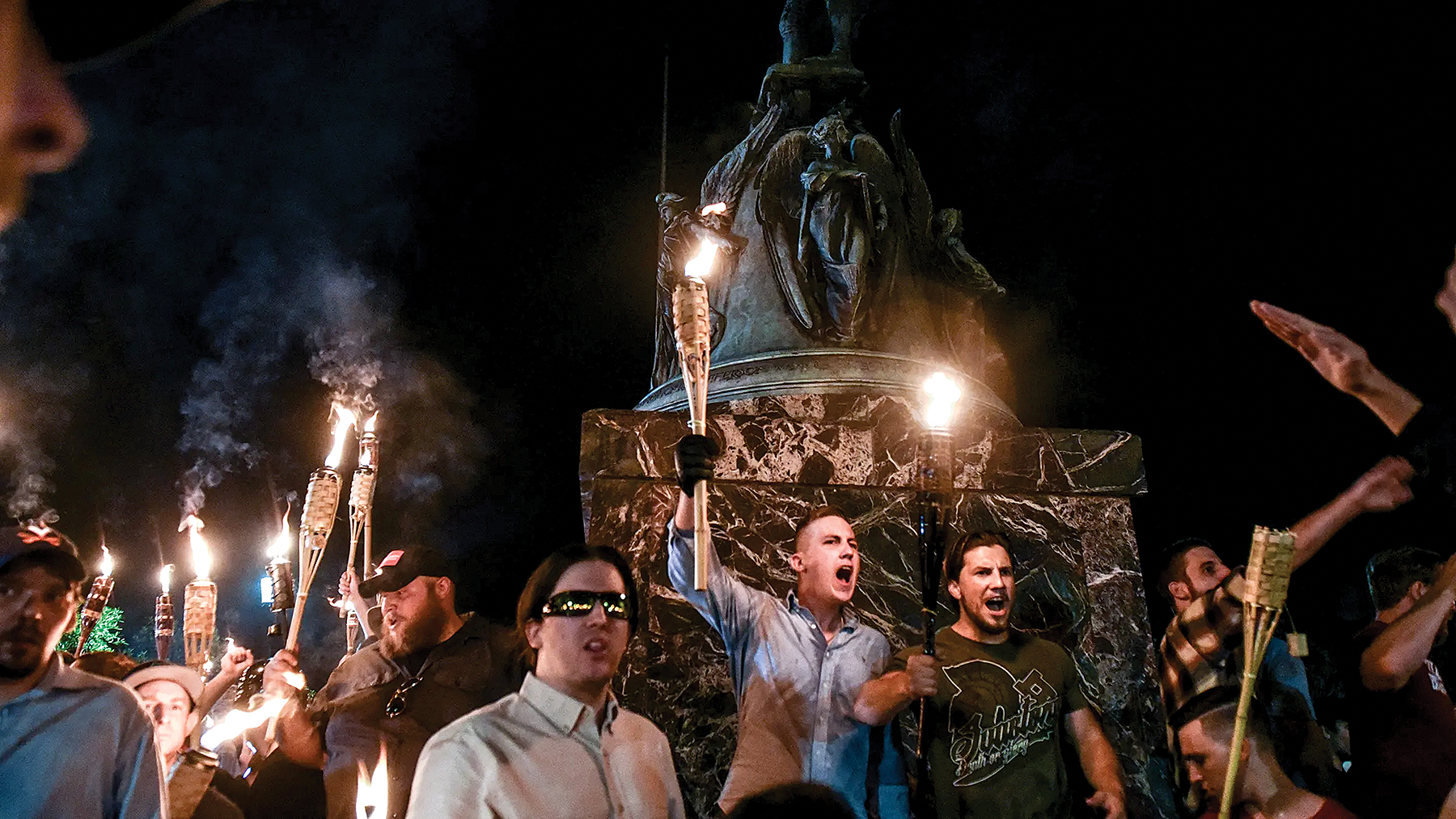
She argues that the hinge of this hatred came in 2016 and with the emergence of Donald Trump as a formidable presidential candidate, prompting the emergence of antisemitism as a major American challenge. The White House has spent months challenging this view and has sought to portray the president as a leading combatant against antisemitism.
One way or another, antisemitism came to full flower with the Israeli military response to the Hamas invasion. “Those who have directly experienced antisemitism in recent years, whether encountering it on social media, on campus, or on city streets, and who no longer feel safe in their synagogues,” she argues, “will undoubtedly carry those memories across their lifetimes as their predecessors did.”
Mark Mazower, a Columbia historian, treads some of the same territory but takes a different view in “On Antisemitism: A Word in History.” “A term that began as a way to describe the hostility faced by Jews as a minority struggling for their legal rights is now used to defend a Jewish majority state depriving the minority within it of theirs,” he writes. “Fighting antisemitism once meant battling ethnonationalism; now it often justifies ethnonationalism’s excess.”
Mazower also seizes upon the irony that, as he writes, “Even racists these days say they are fighting antisemitism, something that would have been have been unimaginable when the term was coined and should itself be a kind of signal that it is now being abused.”
Indeed, abuse is at the center of this debate – the abuse of the term that Mazower identifies, the abuse Jews have felt even in their comfort in the U.S., the abuse Israel experienced two years ago, the abuse wrought on the Palestinians as Prime Minister Benjamin Netanyahu pressed ahead with his military response.
“The enormous attention given in recent times to redefine antisemitism has created its own problems,” he writes, adding, “The concept, which derives its very name from a discredited racial theory, is routinely applied to everything from prejudices and stereotypes to feelings, attitudes, and forms of legislation, not to mention acts of violence ranging from petty abuse to massacre and genocide.”
In this volume, Mazower speaks of the clash between establishment figures, many of them Jews, who “were accustomed to seeing Israel as a plucky and beleaguered underdog and felt outraged” by campus protests and students who “were equally outraged by U.S. support for an occupying force that was systematically evicting Palestinians from the ancestral homes and obliterating much of Gaza.”
The place of Jews in this debate thus ranges from innocent victims of antisemitism to co-conspirators in it. It is an uncomfortable balance. And yet it is not a balance in the scales of justice. It is more fundamentally a story of deep injustice, and how sometimes in history injustice can beget injustice, as unjust as that may be. Θ
David M. Shribman, who won a Pulitzer Prize as Washington bureau chief of The Boston Globe, is executive editor emeritus of the Pittsburgh Post-Gazette and teaches at Carnegie Mellon University and McGill University.


