
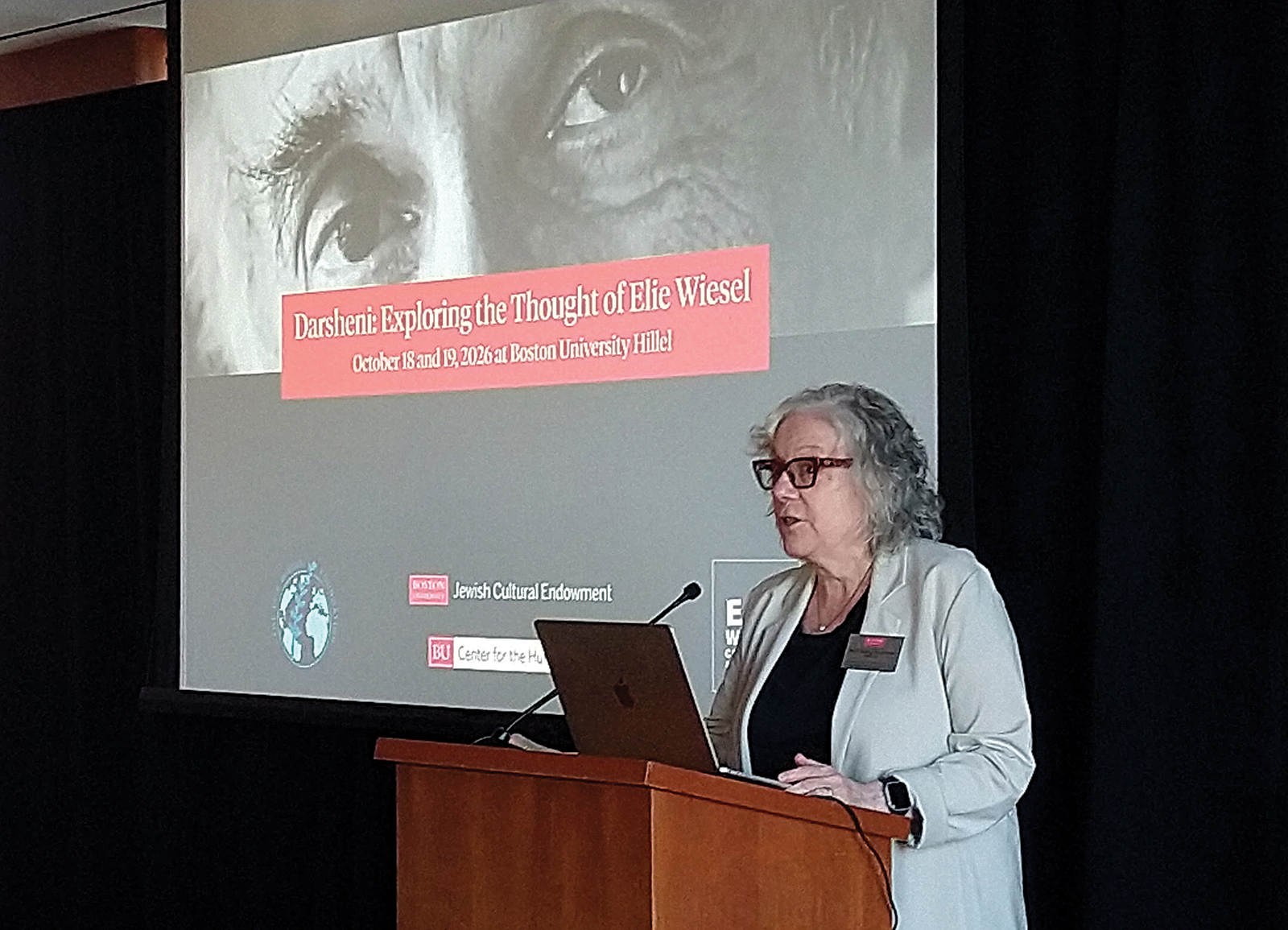
BOSTON — In a poignant tribute to Elie Wiesel, video clips of the late Holocaust survivor and Nobel laureate were shown during a recent conference about his life and legacy.
“Prophets do not seek to be understood or admired,” Wiesel said in one clip. “All they want is to be obeyed.” Invoking three prophets of the Hebrew bible – Elisha, Isaiah and Jeremiah – he added, “Each time I am drawn to a prophet, whether for the majesty of his language or the intensity of his voice, he becomes the melodious center of my inner landscape.”
The conference, “Darsheni: Exploring the Thought of Elie Wiesel,” took place last Sunday and Monday at Boston University, where Wiesel taught for 35-plus years. (“Darsheni” means “Interpret me!” in Hebrew, according to the conference website.) The conference was held just over 10 years after Wiesel’s death at age 87 in 2016. His wife, Marion Wiesel, died last year at age 94.
On the fourth floor of the BU Hillel House, with views of the Charles River and Kenmore Square, attendees listened to various speakers discuss Wiesel’s impact.
“For me, Elie was first and foremost a survivor,” said BU Professor Abigail Gillman, who compiled the collection of Wiesel videos that was screened during lunch.
The clips came from public lectures that Wiesel delivered as a professor at BU. Gillman called these lectures “the best-attended talks of the year,” attracting “the [wider] community as well as BU.”
By all accounts, Wiesel lived an incredible life. It began in his Eastern European birthplace of Sighet, Romania. In the camps during World War II, young Eliezer Wiesel lost his mother, his sister Tsipora and his grandparents. (Older sisters Beatrice and Hilda survived.) He was protected by his father Shlomo until Shlomo died just 10 weeks before liberation by the Allies. Relocating to France after the war, Wiesel first worked as a journalist, then wrote a memoir about surviving the Holocaust. Initially published in Yiddish and titled “And the World Remained Silent,” it was republished in English in 1960 as “Night” and became a bestseller. By then, Wiesel had moved to the U.S. He went on to write around 60 books – works of fiction, nonfiction, even a cantata – on such subjects as the Holocaust and Hasidism. He became a public figure who interacted with world leaders.
Wiesel also had a significant presence on Commonwealth Avenue. Day two of the conference included a midmorning panel titled “The Legacies of Elie Wiesel at Boston University.” There were administrators from the Elie Wiesel Center for Jewish Studies – center director Nancy Harrowitz, and associate director/lecturer Matthew Creighton; Ryan Hendrickson, a research and instruction archivist who discussed the university’s Elie Wiesel collection; and BU student Isabel Rao, who is minoring in Holocaust and Genocide studies and interning at the Wiesel collection. LizAnn Eisen, the new executive director of the New York-based Elie Wiesel Foundation, was also on the panel.
“I took Professor Wiesel’s class in 1997,” Hendrickson recalled during the panel. “It was his policy, if you were his student, he wanted to meet with you personally. I chickened out – what was I going to say to this giant of a person?”
Luckily, there was a second chance years later, in 2011, when Wiesel made his last visit to the BU archives, where Hendrickson was now working.
“I said I was so sorry I never met with you all those years ago,” Hendrickson said. “He was very gracious.”
This semester, BU is offering a new course on Wiesel. Creighton is teaching it, and Rao is taking the class. She has previously taken courses on the Holocaust and fascism in Italy; Islamophobia and antisemitism; and the history of the Holocaust.
Rao referenced a quote from “Night:” “To forget would be not only dangerous but offensive; to forget the dead would be akin to killing them a second time.” And she spoke of how “keeping the memory alive, being a voice for people who are not here, is really important.”
During the Q&A, several audience members asked questions relating to the Israel-Hamas conflict in the wake of the deadly Oct. 7, 2023 Hamas attacks on Israel and Israel’s subsequent, devastating war against Hamas in the Gaza Strip.
“One of the things I remember Professor Wiesel saying is, he would never condemn or criticize Israel’s policies or practices in public,” said questioner Janet Slovin, a former student of Wiesel’s. “It’s not that he would approve of everything Israel was doing. He would get on a plane, meet with the prime minister, make his views known. It was not his place to criticize in public.”
Slovin claimed that in the current moment, Wiesel Center affiliates have been criticizing the State of Israel – which the center’s executive director Harrowitz denied.
“Maybe there’s criticism of the right-wing government of Israel,” Harrowitz said. “A lot of us are critical of the right-wing government. That’s very different than attempting to delegitimize the right of Israel to exist – very, very different.”
In a follow-up conversation with the Jewish Journal, Harrowitz said that she and the center support the State of Israel, and that any criticism of Israel from them is done “to help Israel improve.”
Another issue addressed at the conference is the increasing loss of Holocaust survivors. This arose during the concluding panel, “Where Do We Go From Here? Reflections on the Future of Elie Wiesel Scholarship and Teaching.”
“This is a critical moment,” said panelist Colin Davis of the University of London. “The youngest Holocaust survivors are in their 80s … Soon, there will be nobody left who has a primary memory of the Holocaust.”
“The next generation of scholars will not have known Wiesel directly,” Davis added. “He will be available as a written text, a video archive.” Θ


