
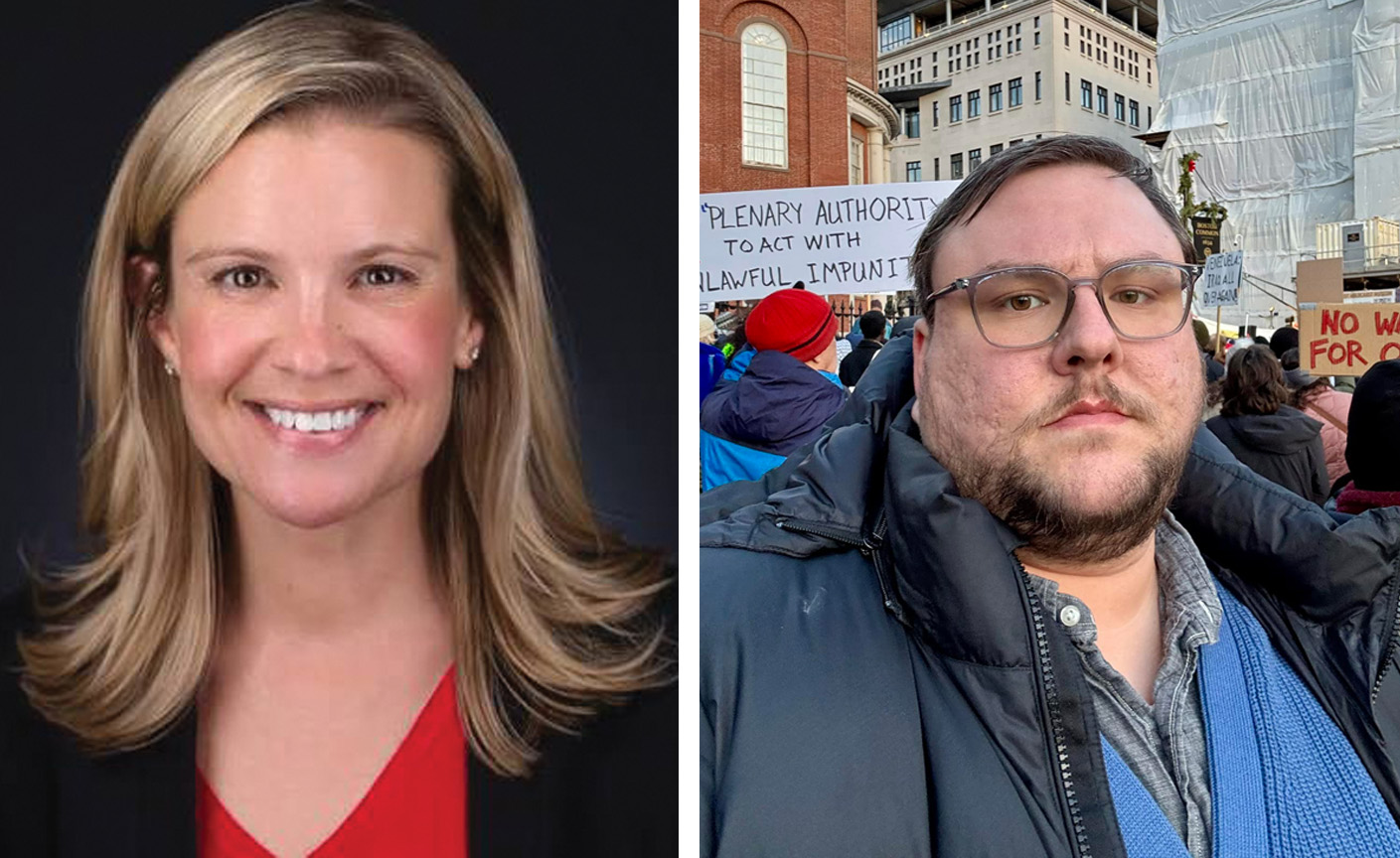
Despite legal and financial challenges, three cities in Greater Boston are all considering measures to divest municipal funds from all companies that aid the Israeli war effort.
In Medford, Mayor Breanna Lungo-Koehn has proclaimed, via a statement from the municipal law firm KP Law, that the “City of Medford hereby stipulates and agrees that it will not enforce, implement, or [attempt] to enforce or implement the Values-Aligned Local Investments Ordinance.”
The ordinance would cancel all investments in companies manufacturing weapons, producing fossil fuels, operating private prisons or contributing to regimes that commit severe human rights violations, including practicing apartheid or genocide.
Medford’s city council originally passed the measure in August 2025; ; Lungo-Koehn vetoed it in October 2025; and the city council overrode her veto, 6-1, the following month. Two Jewish Medford residents, Zachary Chertok and Eliot Jokelson, then legally challenged the ordinance in federal court, where a preliminary injunction was issued against its enforcement.
Lungo-Koehn maintains the ordinance violates state and federal laws because no Massachusetts statute authorizes municipalities to mandate divestment based on political, moral, or ideological criteria.
She also believes defending the city against lawsuits – including those brought by well-financed pro-Israel organizations such as the Gevura Fund and the National Jewish Advocacy Center, who backed the current legal challenge – would make enforcing the ordinance prohibitively expensive. She said Medford has already spent $35,000 of a tight city budget addressing legal challenges to the ordinance, and that the city would have to allocate another $500,000 in attorney’s fees to continue fighting.
Medford City Council President Isaac “Zac” Bears disputes Lungo-Koehn’s account. At his urging at its Sept. 15 meeting, the council passed, 6-1, a formal declaration stating that the mayor had not given the council updates on litigation expenses prior to issuing her stipulation. Had the council been informed of the $35,000 in legal fees, it would have told the mayor that such expenditures were justified and to enforce the divestment ordinance, not support the preliminary injunction, the declaration said.
In neighboring Somerville, a proposed Ethical Procurement and Investment ordinance is still under consideration by the city council’s Legislative Matters Committee. In November 2025, voters approved a ballot question that required Somerville to enact an ordinance prohibiting the awarding of contracts to companies that “engage in business that sustains Israel’s apartheid, genocide, and illegal occupation of Palestine.”
Several city councilors then introduced a measure that would prohibit Somerville from contracting with corporations that do business with countries that engage in “apartheid, genocide or unlawful military occupation,” or engage in conduct that violates international humanitarian law, “including without limitation in Israel and Palestine.”
Legislative Matters Committee members discussed the proposed ordinance at their meeting on June 30. They heard public comment on Sept. 8, when 38 residents spoke in favor of the measure and 23 opposed it. On Oct. 13, the committee passed, 4-1, an amendment to the proposed ordinance that, while maintaining the prohibition on spending city funds on companies with “direct, ongoing, and knowing involvement in specified objectionable conduct,” carved out an exception for sole proprietors.
The committee met again on Oct. 27, but the divestment ordinance was not on the agenda.
Finally, on Oct. 19, neighboring Cambridge considered two policy orders that would have the city divest city workers’ pension funds and cancel all city contracts with companies that are “complicit in the genocide, apartheid, and occupation of Palestinians.” That determination would be made by the nonprofit American Friends Service Committee (AFSC).
Perhaps mindful of potential legal challenges, the councilors introducing the measures, Ayah A. Al-Zubi and Jivan G. Sobrinho-Wheeler, also asked the city solicitor to determine whether the city could legally boycott the companies on the same grounds.
More than 260 Cantabridgians spoke on the measure: about 165 in support and over 100 opposed. After six hours of public comment, the meeting was held over until the next morning.
The divestment order cites a report from Cambridge for Palestine, which identified nearly $24 million in city pension funds tied to companies named on the AFSC shortlist for “having severe and consistent involvement directly contributing to genocide, apartheid, and occupation of Palestinians.” The list includes companies with locations in Cambridge such as Boeing, Palantir and RTX (Raytheon).
Mayor Sumbal Siddiqui called a special meeting to address the two policy orders for Oct. 28. Siddiqui did not include a public comment period, citing the public’s “ample opportunity to comment on these matters on Oct. 19, and [the public] still has the opportunity to submit written communication.”
The outcome of the Oct. 28 meeting was not known before press time. Visit jewishjournal.org for updates to this developing story.
Contact reporter Brett M. Rhyne at brett@jewishjournal.org.


One Response
These darn* BDS bills are all alike in that they assume something that doesnt exist–Israeli human rights violations as a matter of policy. On slanted floors like the City Councils of those 3 heck*-holes (I know, I was in the Medford one) the appropriate and factual denials of those Goebbelsian blood libels won’t get a fair hearing but hopefully in an unbiased court it could, and that is the ground to fight the laws on. Disprove those allegations & no company is supporting “Israeli apartheid” because it doesnt exist.
*I’m thinking stronger language