
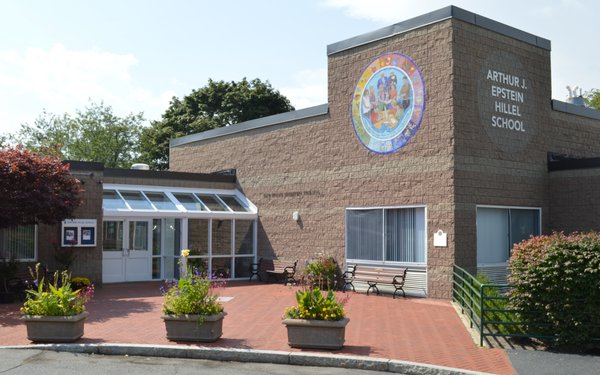
Marblehead’s Epstein Hillel School was one of 36 Jewish nonprofits to receive grants from the state totaling nearly $2 million to enhance physical building security and/or fund security personnel during the state’s current fiscal year.
The school received $51,092 for building security and $30,800 for security personnel.
“Our board, staff, and families are very grateful to the commonwealth and to the Marblehead Police Department for recognizing what’s changing in the world around us and for their ongoing commitment to helping us find practical ways to improve our school’s security,” noted Michael Slater, EHS director of finance and operations, in a written statement.
“This is the second time that EHS has been awarded a state security grant,” added Tamar Skowronski, the school’s marketing and communications manager. “In 2022, the school received $45,000 for upgrades to security cameras and alarms and to make other safety improvements.”
The grants, announced last month by the state Executive Office of Public Safety and Security and awarded through two programs managed by the Office of Grants and Research, were given to health care providers, faith-based and community organizations, and other nonprofits to protect against hate crimes or terror attacks.
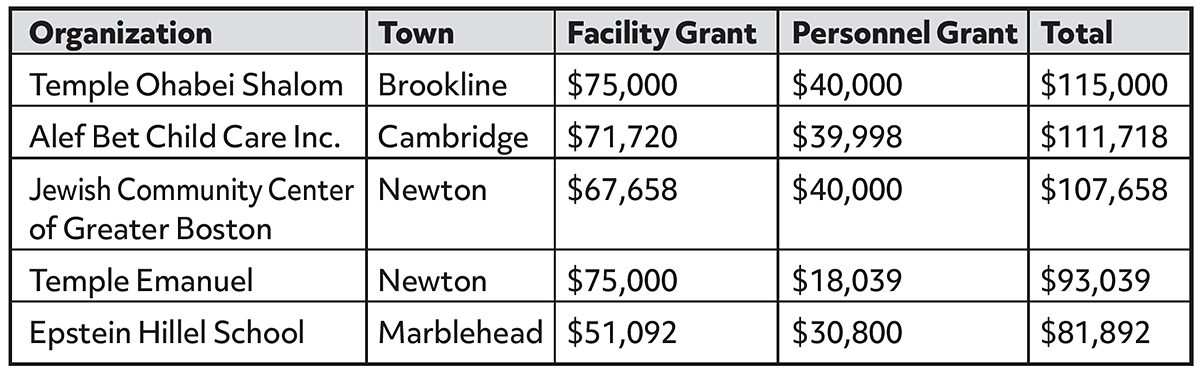 The top five Jewish state security grant recipients./SOURCE: Office of Grants and Research
Criteria for the grants included demonstrating “greatest need and cost-effective solutions” to address “building safety and security shortfalls to enhance the safety of all in the event of an incident,” according to the grants office. Applicants also were asked to prove through supporting documentation “their high risk for a terrorist attack or hate crime, including details of any previous documented threats, vandalism, and/or instances where an attack or crime took place.”
In addition, personnel grant applicants were required to submit a letter signed by their local police chief stating the department was consulted and approved of the plan for security personnel submitted, which was referenced in Slater’s statement.
In total, about 40 percent of the grant money – $1,966,455 out of $4,945,000 – went to Jewish congregations, schools, and other groups. Jewish organizations received about a third of the facility grants distributed – 24 out of 82 – and a whopping 18 out of the 20 personnel grants.
At $81,892, EHS’s total grant was the fifth-largest among Jewish nonprofits. First was Brookline’s Temple Ohabei Shalom, which asked for and received the maximum for both grants – $75,000 and $40,000 – for a total of $115,000. Rounding out the top five were Cambridge’s Alef Bet Child Care ($111,718) and two Newton organizations, the Jewish Community Center of Greater Boston ($107,658) and Temple Emanuel ($93,039). In all, 12 Jewish groups received the maximum security grant of $75,000 and five received the maximum security personnel grant of $40,000.
Under the Biden administration, security grants also were available from the federal government. Additionally, in 2024, Combined Jewish Philanthropies awarded $1.6 million in grants to 160 organizations, including providing funds to some groups for hiring a writer to help draft grant applications.
“What happens is, they apply one year, they don’t get it,” said Jeremy Yamin, CJP’s vice president for security and operations. “We make some correction suggestions, then they get it the next year. It’s sort of a long-term thing. We’ve worked with pretty much all of those organizations that were awarded a grant in the last couple of years.”
Access control for facilities is a major security issue, Yamin said. “The reason being that when these structures were built 20, 50, and 150 years ago, they were built to be open and welcoming, not safe and secure. So the balance is, how do you adapt these buildings? Help to adapt the buildings to make them safer so they can still be used for being an open and welcoming space, but also that the doors close and lock and that you don’t have all the windows open or whatever it is that the building needs.
“One institution might have already improved the front door, but now they have a preschool entrance, or they’ve done all their doors, but they’re worried about what if there was an active assailant? Where could we run and hide? How could we temporarily shelter in place, or we need better camera coverage and camera systems.”
Yamin thanked all the state officials who worked to increase state security grant funding. “It’s so expensive and it’s almost a tax on Jewish institutions to have to provide for additional security infrastructure or security guards. So the commonwealth has been very important, because the federal government doesn’t cover everything, and the commonwealth has been very helpful and proactive in saying we need to provide some support, as well.” Θ


