

The idea behind the new, more secure entrance to the Jewish Community Center of the North Shore is fortification on several levels. It bolsters this hub of Jewish life – where visitation numbers are breaking records – and adds a layer of security that, in an age of rising threats, allows that community to flourish unburdened.
The dollars behind that new entrance tell a story, too. Marty Schneer, the Marblehead institution’s executive director, said that last year’s $2.5 million capital campaign met its goal early, reflecting North Shore Jews’ commitment to reinforcing community.
“People like the work that we do, and feel that we manage this community asset in a responsible way,” said Schneer, adding that the JCC simultaneously met the annual giving goal that sustains its $9 million operating budget. “They recognize that we’re providing a lot of services – to families, to children, to the elderly, cultural programming.”
Across the region, Jewish institutions report that giving is up – and community security is a priority, with donors opening their wallets for items like the JCC’s more secure entrance. They are also targeting dollars for priorities like combating antisemitism, reinforcing bonds with Israel and supporting the growing needs of local families in uncertain economic times.
“The Jewish community is incredibly, incredibly generous,” noted Jennifer Weinstock, executive vice president at Combined Jewish Philanthropies. That 130-year-old organization made $64 million in grants this year to some 250 organizations; most are in eastern Massachusetts, while others, such as Birthright, have a national scope and a global mission.
“I think we punch way above our weight, if you look at other similar-sized Jewish communities,” Weinstock added, “both in giving to Jewish organizations and also in giving Jewishly to the broader world.”
A significant number of this year’s CJP grants went to bolstering community safety, and nearly half were aimed at programs creating vibrant Jewish community life. Beyond that, a particular focus has been finding nonpolitical ways to strengthen the bond between Israel and its local diaspora.
As complicated as that relationship has been since the October 2023 Hamas massacre and the Gaza War, “These are our people. Our fates are tied,” Weinstock pointed out. “Half the world’s Jews still live in North America, with 300,000 or more in Boston. We need to ensure that the ties that bind the area Jewish community to Israel and Israelis are still incredibly strong.”
To that end, CJP is funneling dollars to efforts aimed at doubling the number of people traveling to Israel each year. Other key initiatives include supporting Israeli staff at local Jewish summer camps and a fellowship program that brings Israelis to study at Harvard’s Kennedy School of Government.
Donations are also pouring in for CJP’s new allyship grants, which enable grassroot efforts to build community through organizations like Lexington United Against Antisemitism, an interfaith Christian-Jewish initiative.
But Weinstock emphasized that philanthropic energy is also firmly behind what she calls “joyful Jewish experiences,” from preschool to summer camps and holiday events. “That is who we are,” she explained, “and we cannot let that be second class to all of the hard things.”
Still, the historic uptick in antisemitism is a decided motivating factor for donors to Lappin Foundation, according to Sarah Ovadia, its director of development. The organization was known for its programming around the Holocaust, antisemitism and Jewish culture well before Oct. 7 – but its profile rose significantly afterwards, when Lappin officials testified publicly about antisemitic violence.
“We were used as a model organization that has effective best practices for combating antisemitism through education,” Ovadia said, adding that Lappin’s programming has attracted inquiries from both public and private schools around the state. The foundation has also benefited from the advocacy of high-profile Boston philanthropist Josh Kraft, the son of Patriots owner Robert Kraft and head of Kraft Family Philanthropies.
Ovadia said that Lappin was on track to meet its current annual goal of raising $900,000, with recent donor enthusiasm leaving foundation officials “pleasantly surprised and really pleased.”
“And it’s not just the antisemitism – it’s important to note that our beautiful cultural programming, celebrating holidays, introduction to Judaism, Black-Jewish relations, all of these programs have grown,” Ovadia added. “We see Jewish pride forming around that. People are looking for that sense of Judaism and community.”
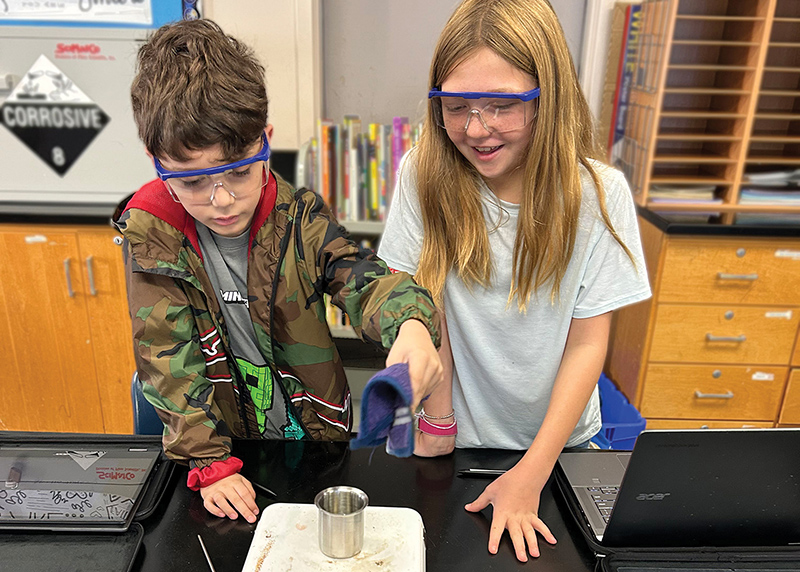 Epstein Hillel students Godric Laird and Ada Freudenberger work on a science project.
They find both at Epstein Hillel School in Marblehead, which is celebrating its 70th year – and benefiting from a growing and “very loyal” donor base, according to Head of School Amy Gold. The private school, which serves kindergarten through Grade 8, saw its student population double during the pandemic and has continued to expand. Gold said Epstein Hillel’s philanthropic priorities include nurturing that rise in enrollment and reconnecting with alumni who may have moved back to the area.
The school is also benefiting from a recently established partnership with the JCC of the North Shore, with which they share a campus. Gold said donors had been excited about the potential offered by the collaboration, including last summer’s jointly offered STEM camp and new preschool initiatives.
Schneer said the JCC has advised Epstein Hillel around programming and outreach. “We are a small Jewish community with a number of institutions,” he said, “and the fact that the JCC has been quite successful over the past decade or so encourages people to seek our support and our help.”
Schneer also pointed to a philanthropic trend toward donations earmarked for specific items, such as early childhood education. “Particularly for younger generations, people will target money for things like our inclusion day camp, which serves children with special needs,” he said.
Studies show that millennials in particular are an especially generous demographic – and as they hit their prime earning years, that 40-something generation is bolstering organizations that reflect their priorities.
That impulse is evident at Jewish Family & Children’s Service of Greater Boston, a 160-year-old outfit that has noted an uptick in philanthropic engagement. Speaking during an emergency effort to marshal food assistance to local families affected by cuts to the federal SNAP program, Gail Schulman, the organization’s CEO, praised a community that steps up.
“People are giving more because they’re seeing more need,” she said. “There are many priorities in the world, and the work that we do addresses priorities that people can see in their own eyes every day. It’s really hard to ignore when you see a hungry person, or a person who’s aging and doesn’t have a place to live, or somebody with disabilities who’s being ignored by government systems.”
At JF&CS, Schulman oversees a $32 million operating budget that has grown alongside the organization’s clientele – about 15,000 people annually, increasing at a rate of 1,000 per year. Recently, the organization’s food pantry has been serving three additional households each week, or a dozen new households per month.
Meanwhile, calls from families seeking help for people with disabilities have risen 22% this year, Schulman added, while inquiries from families needing emergency financial assistance have increased by nearly 50%.
And while the absolute number of Holocaust survivors is not growing, their needs are increasing as they age into more vulnerable years. As a result of a recent outreach effort, 600 survivors were added to JF&CS’s existing roster of 400-plus recipients of services like nutrition assistance.
All of these needs are visible to the community – and donors have responded in greater numbers than ever. “There is a visceral, in-your-face reality to the work that we do that is inspiring,” Schulman noted. “People want to roll up their sleeves. They want to come help us as volunteers, and they do – and then oftentimes they want to open up their wallet as well.
“It’s part of our tradition – the way that our community steps up,” she added. “And I would say that collectively, they have done a great job of instilling a sense of shared purpose in our local Jewish community.” Θ


