
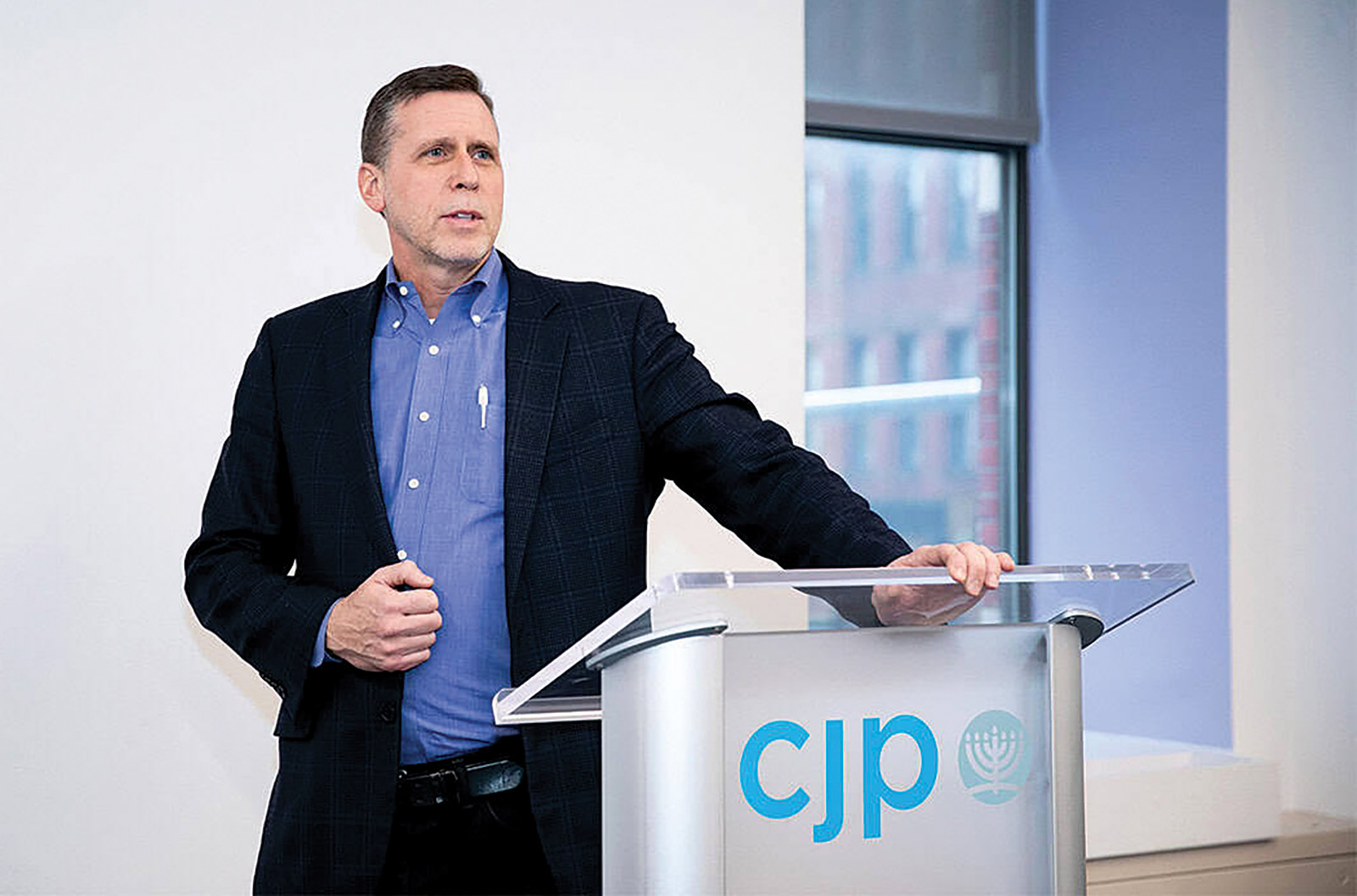
As the number of antisemitic incidents in Massachusetts has reached unprecedented levels and violence against Jews nationwide has increased – and synagogues in Michigan and Mississippi have been attacked – a CJP security initiative is playing a critical role in keeping synagogues and Jewish organizations safe in greater Boston.
In the past year, the Communal Security Initiative (CSI) provided more than $1 million in direct security grants to some 250 Jewish organizations, and assisted in managing 150 incidents.
In addition, CSI has conducted over 600 proactive security consultations and led hundreds of security training sessions attended by more than 5,000 professionals and lay leaders at area synagogues and other Jewish organizations.
Temple leaders say CSI has been an indispensable partner in providing training, consulting and financial support in strengthening their security programs.
“I have them on speed dial,” said Ellen Dietrick, senior director of education and engagement at Temple Beth Shalom in Needham, who has called on CSI for everything from active threat training for staff to security assessments.
Prior to the attack on the Tree of Life Synagogue in Pittsburgh in 2018, in which 11 congregants were killed in the deadliest attack on a local Jewish community in U.S. history, security was not a major concern for most Jewish organizations.
The increase in anti-Semitism post-Oct. 7 has since added to those concerns.
“A decade ago, the doors were unlocked at many synagogues, sometimes there might not even be anybody in the building, and there was pretty much no security except sometimes on the High Holidays,” said Jeremy Yamin, vice president of security and operations at CSI.
CSI is playing a critical role in strengthening security at Jewish institutions throughout the region. When the organization was launched in 2016, Yamin, a former special agent with the State Department’s Diplomatic Security Service, was the sole employee and had a $10,000 budget.
Today, its annual budget is $3.5 million and there’s a staff of five, including CSI Director Daniel Levenson, a member of the FBI Mass Bay Threat Assessment Team and a former associate regional director at the Anti-Defamation League (ADL) in New England.
The increased focus on security is reflected in the budgets of virtually all the Jewish organizations in Greater Boston, where armed guards – supported, in part by CSI grants – at Friday night services are not unusual and de-escalation training for professional and lay staff is commonplace.
CSI’s funding and professional staff support has played a critical role in “creating safe and welcoming Jewish spaces,” said Rabbi Marc Baker, CJP’s CEO. “Strong and thoughtful security measures enable our community to gather, worship, live and work with the confidence that safety has been considered and prioritized.
“Given the alarming number of antisemitic incidents in the past few years, I cannot overstate the importance and impact of CSI’s trainings and assessments, consultation, security grants, and incidence response.”
At Congregation Shirat Hayam of the North Shore in Swampscott, Rabbi Michael Ragozin praised CSI for its support in conducting “a ton of trainings” dealing with such topics as active threats and medical issues. He said CSI has also conducted walkthroughs to assess security and assisted temple leadership in creating security plans.
In Beverly, Rabbi Alison Adler of Temple B’nai Abraham recalled contacting Yamin last summer when there was some concern by congregants about the safety of their popular Shabbat by the Sea event.
“He helped our temple leadership figure out an approach that was both sensible and cautious without reacting out of fear. They’re great. They’re a phone call away all the time,” she said.
Even though CSI has provided direct grants to some 250 synagogues and Jewish nonprofit organizations in Greater Boston and assisted more than 50 Jewish organizations in gaining access to some $3.3 million in federal and state security grants, the cost of security remains a burden for the community.
This fiscal year, Yamin said CSI is planning to increase its direct grants from $1 million to $1.8 million to meet a growing need for support. No other Jewish federation in the country is providing this level of direct security grant CSI funding, he said.
At Temple Israel in Boston, Dan Deutsch, executive director, said the annual security budget has increased by more than 40% in the last five years. Ragozin of Congregation Shirat Hayam said the increase in security costs at his synagogue has been equally dramatic.
Adler in Beverly said her board needs to fundraise for security initiatives every year and she’s looking outside of the Jewish community to try to find some support.
Yamin said a few organizations spend between $400,000 and $500,000 on security and, based on CSI’s security assessments, many of the Jewish institutions, including synagogues, Jewish day schools, and Jewish social service organizations within Route 495 could use about $200,000 annually each for security.
Cybersecurity, he said, has become an increasingly important area of focus for CSI, as ransomware attacks have become a major concern. More than 10 cyber incidents have been disrupted, he said, due to CSI-funded cyber assessments, training and response support.
An important aspect of CSI’s efforts is partnering with area police departments through grants, training and recognition events, including honoring area law enforcement officials for their support of the Jewish community.
As part of the partnership initiative, the Boston Police Department was awarded a $120,000 grant to set up security cameras that could monitor 10 different Jewish institutions and plans to expand the program to a number of suburbs, Yamin said. Θ


